See What Changed Between Two Text Files

TL;DR: Text Compare is a free online tool that shows the differences between two text or code files — side by side or unified, changed words highlighted — right in your browser, no signup, nothing uploaded or transferred.For code, configs, logs, or any two versions of the same file.

Start Comparing Text…
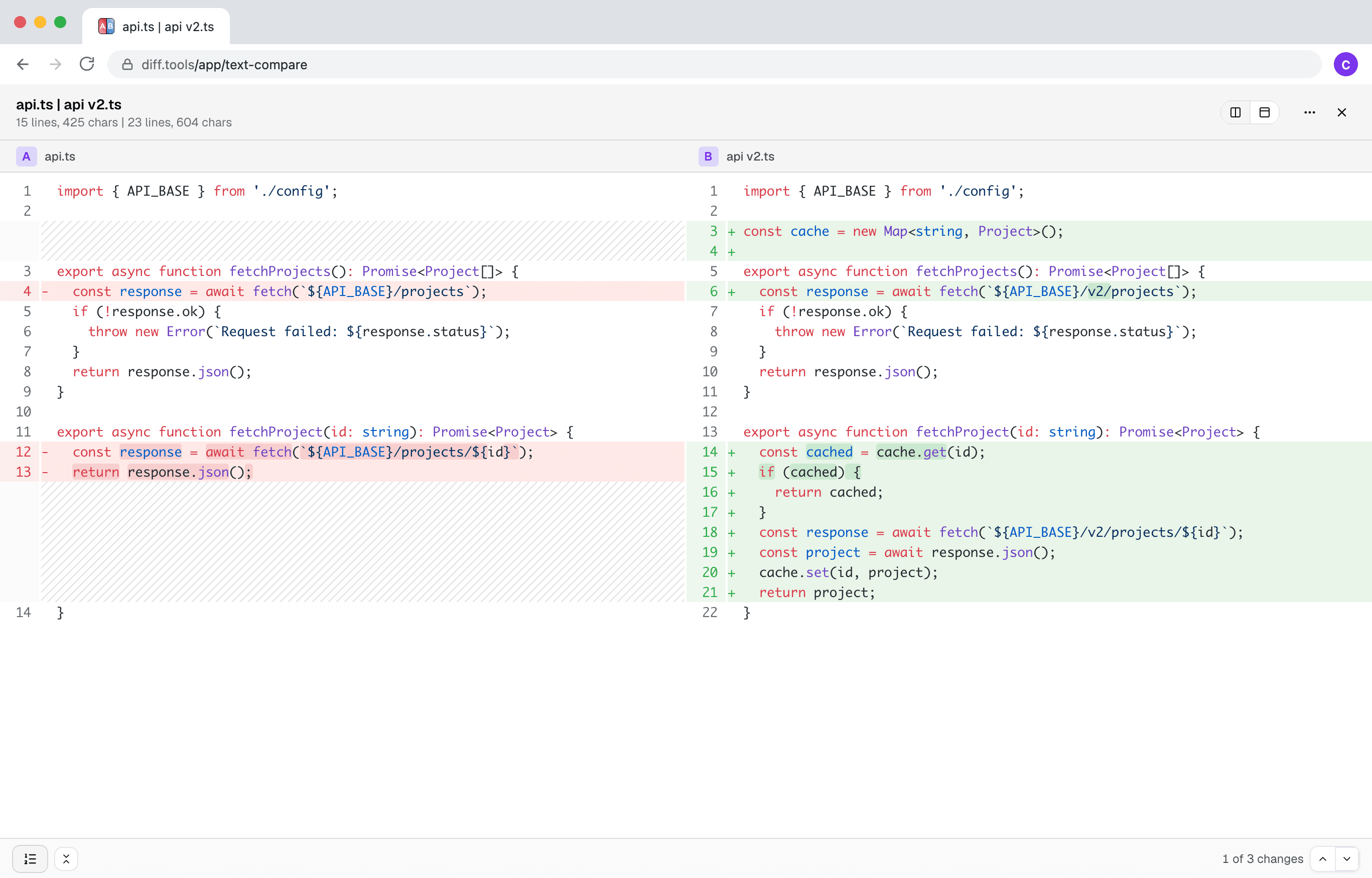
Screenshot of Text Compare
Christopher Atlan

Built by Christopher Atlan at Leitmotif GmbH. Making file-comparison tools since 2020 — building software for over 18 years. diff.tools is one idea: a focused tool for each format, with results you can hand from one tool to the next.

A quick tour

  1. A diff you can actually read

    Side by side or unified, with syntax highlighting and the changed words marked inside changed lines. Unchanged sections collapse out of the way, and previous/next buttons walk you through the changes one by one.
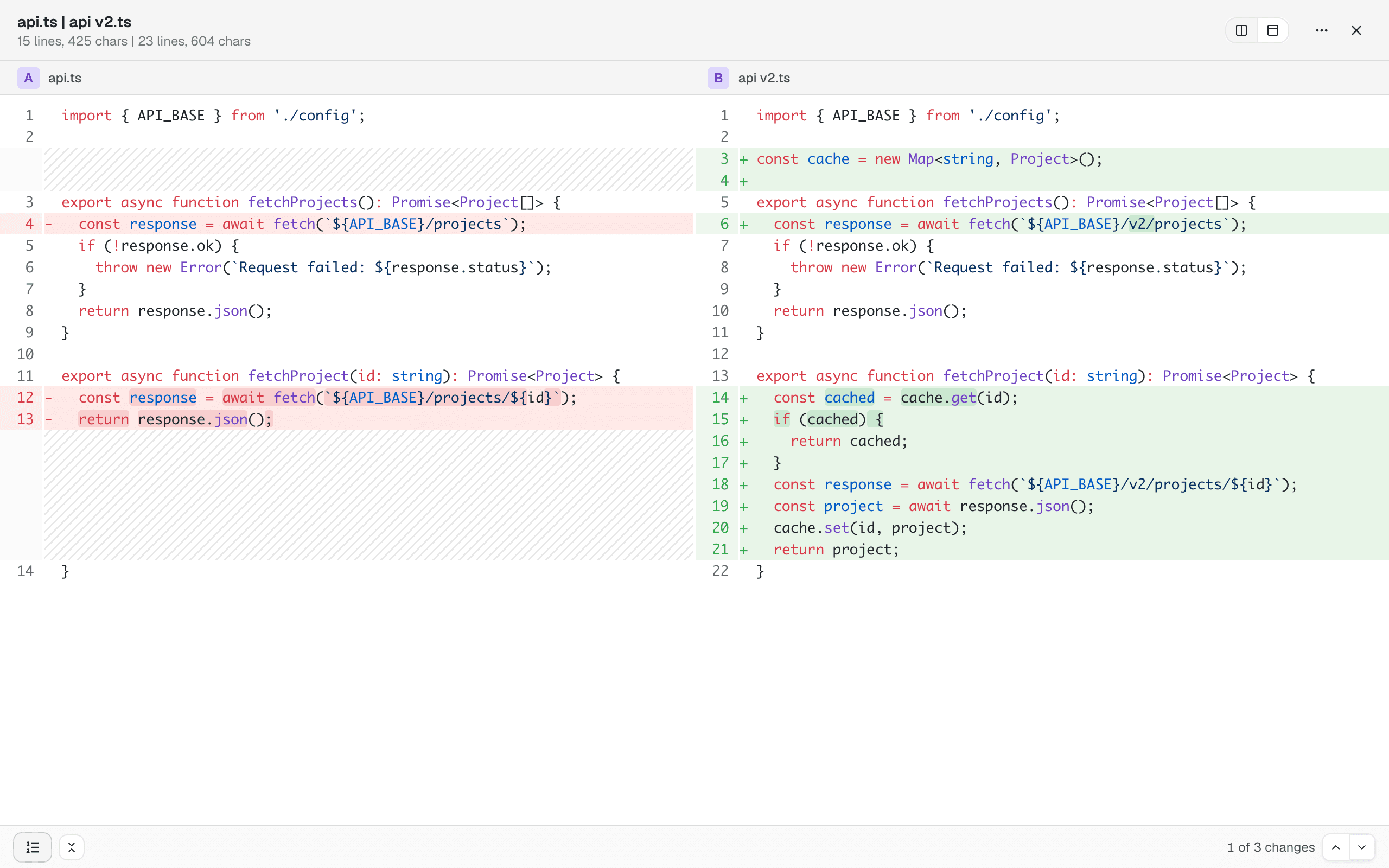
    Two versions of a TypeScript file side by side: added lines green, removed lines red, changed words highlighted within lines
  2. It reads formats, not just characters

    Config files rarely differ where it matters — they differ in formatting, key order, and comments. JSON, JSONC, JSON5, YAML, TOML, and XML are normalized before comparing, and binary plists become readable text, so the diff below shows the one real change between a commented JSONC file and its minified export. A toggle brings back the files exactly as they are.
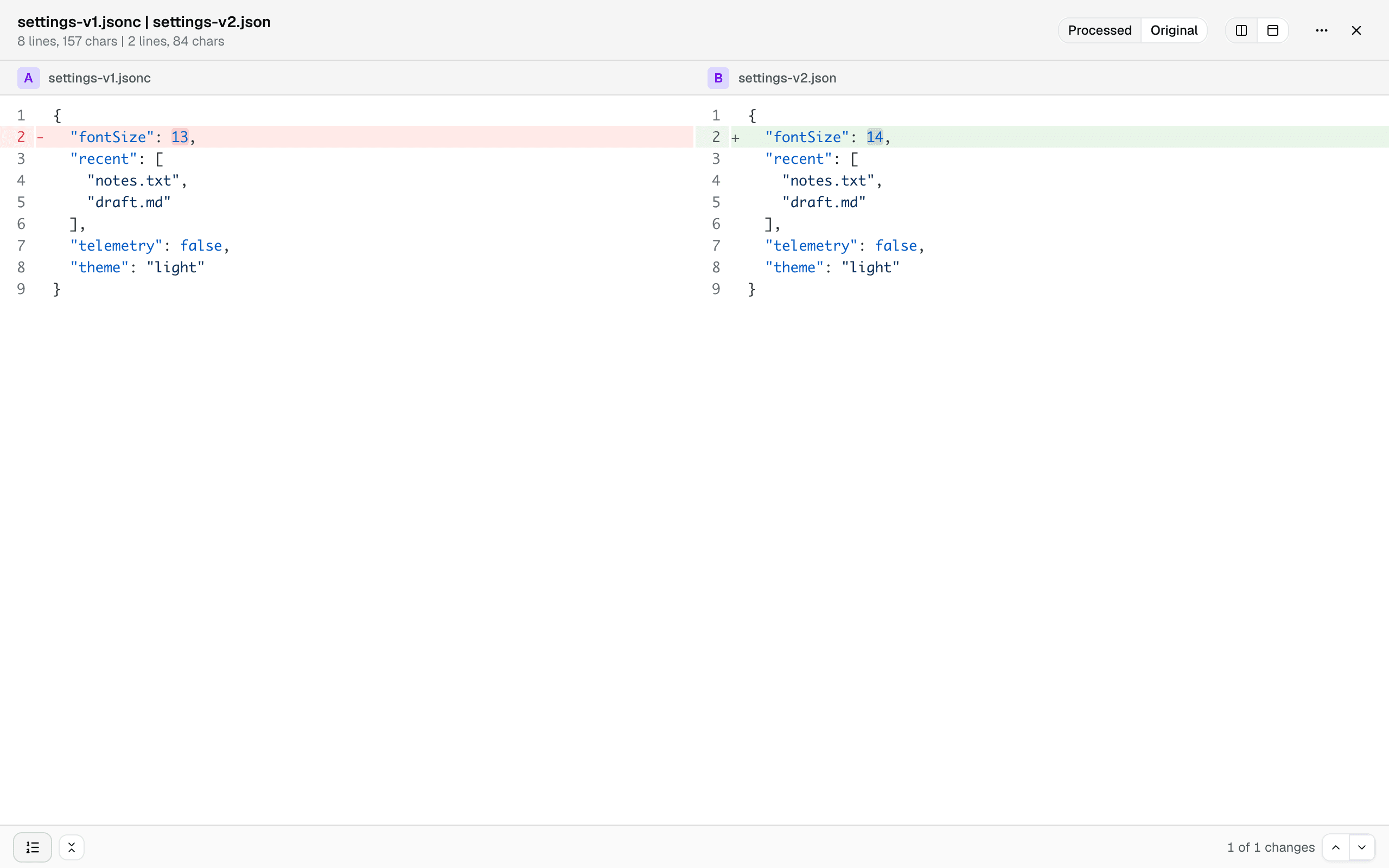
    A JSONC file and a minified JSON file compared as processed text: formatting and comments normalized away, only the real value change remains, with a Processed | Original toggle in the toolbar
  3. Share it, or hand it off

    A comparison survives a reload and can be shared as a link. And when a file turns out not to be text at all, one click hands the pair to Hex Compare for a byte-level look.


How to compare two text files?

  1. Open the free text comparison tool — it runs in any current browser, on your device, no signup.

  2. Click Choose Text A and pick the first file, then Choose Text B for the other one.

  3. Read the diff side by side or unified, and jump from change to change. If a file is a config format, it's normalized first so you only see real changes.

Frequently asked questions

  1. Does it work for code?

    Yes. Syntax highlighting, line numbers, and collapsible unchanged sections — the diff reads like your editor.

  2. Can it compare JSON, YAML, or plist files?

    Yes, and smarter than character by character: binary plists become readable text, and JSON, JSONC, JSON5, YAML, TOML, and XML are normalized (formatting, key order, comments) so the diff shows real changes, not noise. A toggle switches back to the files exactly as they are.

  3. Are my files uploaded?

    No. The comparison runs entirely in your browser; file contents never leave your device.

  4. Can it edit or merge the files?

    No — it shows differences, it doesn’t change files. Editing is on the roadmap.

  5. Which browsers are supported?

    Any current browser — Chrome, Edge, Firefox, and Safari all work.

Requirements

Any current browser.

Privacy & Data Processing

Privacy and security aren't just something you should hope for — they're something you should expect. Modern browsers allow us to process everything directly on your device, which means we never upload, transfer, or share your files.

Your files stay completely private. All comparisons happen locally in your browser. Your data stays your business.

LeitmotifChristopher Atlan
+2

The team behind the tool

We're Leitmotif, a small company from the Alps — Carinthia, Austria and Bavaria, Germany. File comparison is what we do all day: we make Kaleidoscope, the Mac diff app, and diff.tools brings that experience to the browser.

We believe professional tools should be beautiful to look at and fun to use, while giving you all the power you need to get the job done. And we respect your files too much to ever upload them — everything here runs on your machine.

Feedback

We're constantly improving our free online text comparison to make it faster and more accurate. Share your feedback and help us understand what kind of files you compare.

Share this page

FacebookLinkedInRedditLINETelegramWhatsApp